Beta Amylase Starch: Process Guide for Maltose Production
Guide to beta amylase starch conversion for maltose-rich syrups, brewing, and malt extract with process conditions, QC, and sourcing checks.
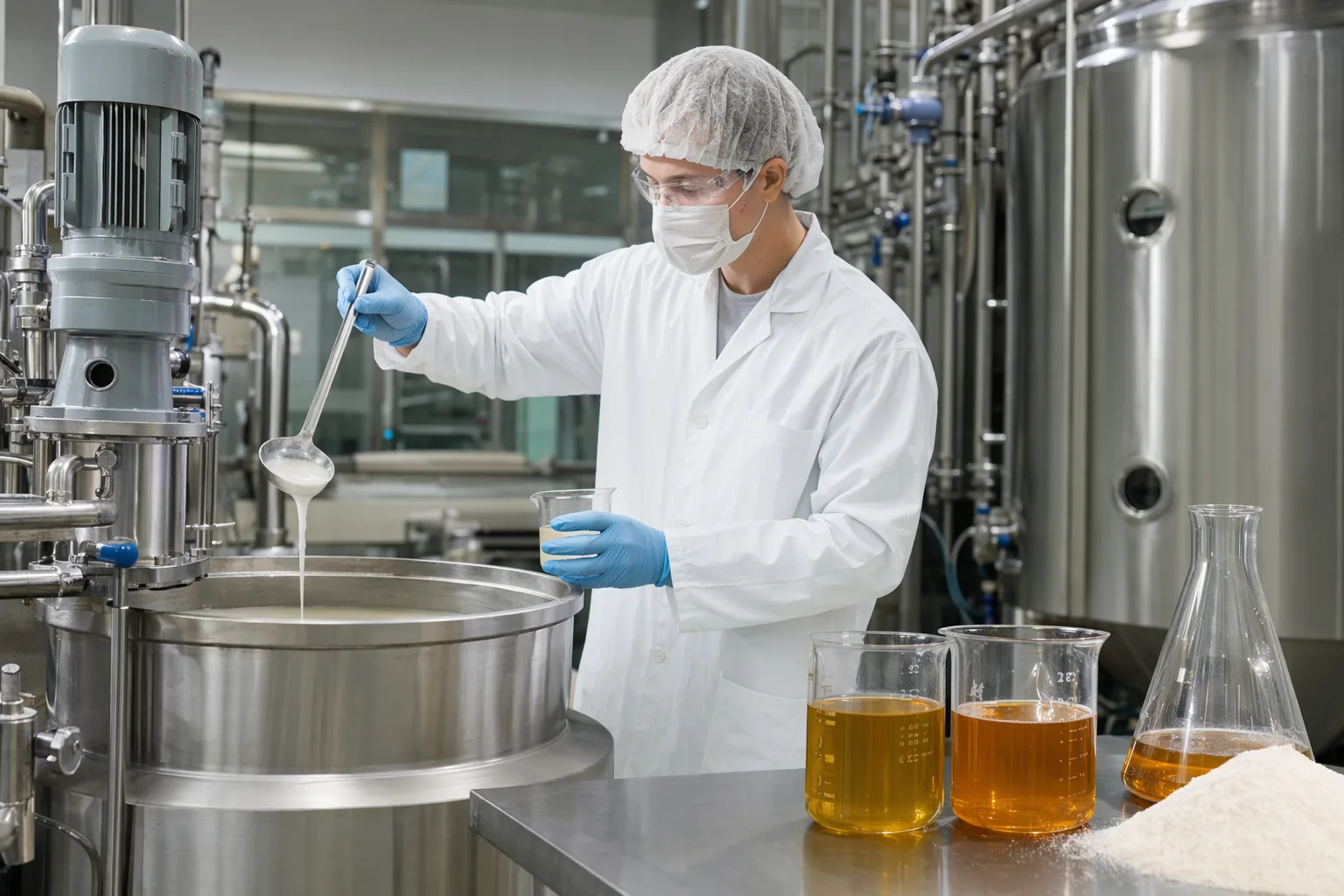
Beta amylase is a saccharifying enzyme used to convert liquefied starch and dextrins into maltose-rich profiles for brewing, malt extract, and syrup production.
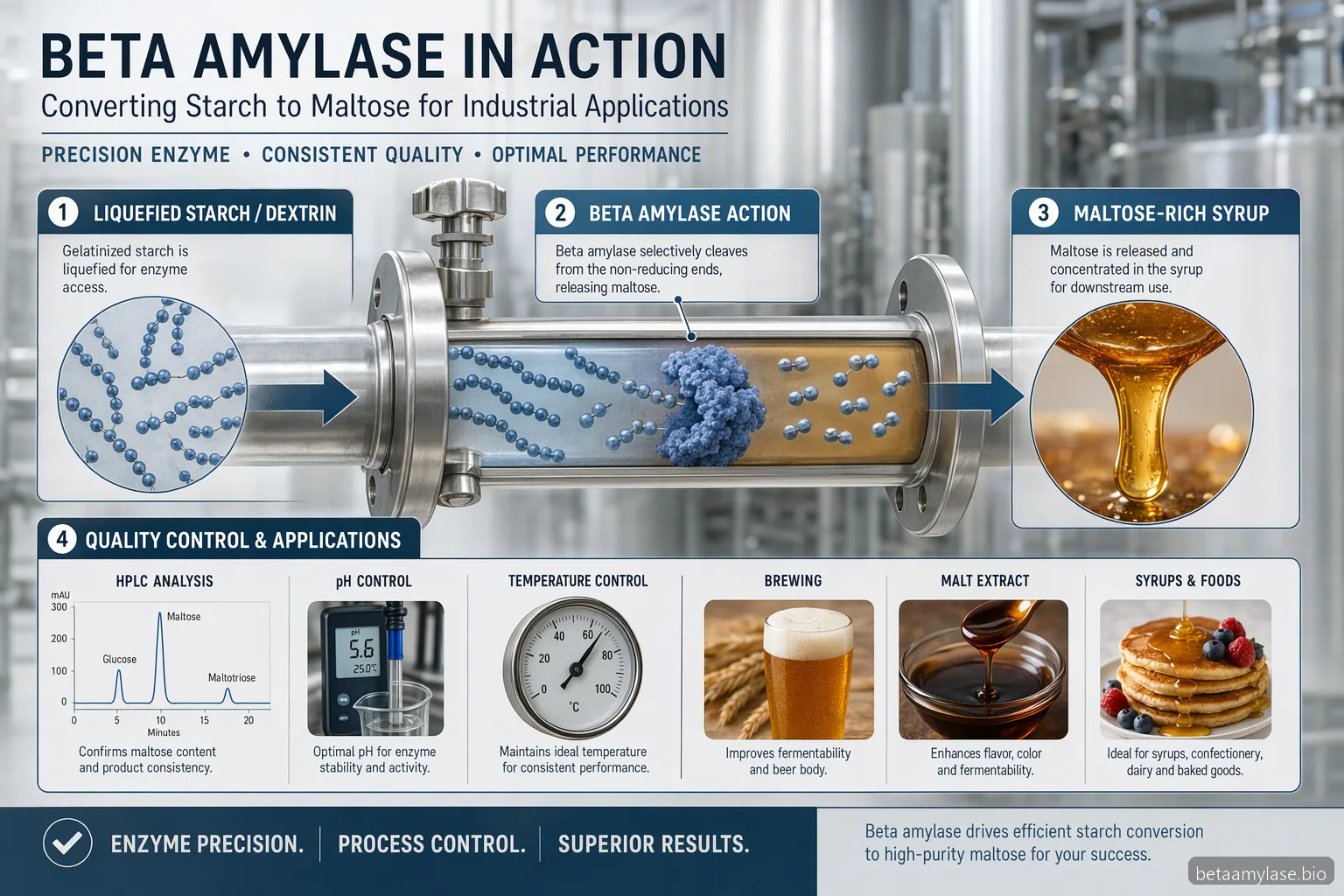
What Beta Amylase Does to Starch
In a beta amylase starch process, the enzyme acts from the non-reducing ends of gelatinized or liquefied starch chains and releases maltose units. It is therefore valued where a maltose-rich sugar spectrum is required rather than complete conversion to glucose. The starch beta-amylase reaction is most efficient when alpha-amylase has already reduced viscosity and created accessible dextrin ends. Beta amylase cannot bypass alpha-1,6 branch points, so the final carbohydrate profile depends on the amylose-to-amylopectin ratio, prior liquefaction, and any debranching strategy. For industrial buyers, the practical question is not simply enzyme activity, but how the beta amylase enzyme performs in the actual substrate, dry solids, pH, temperature, hold time, and downstream filtration conditions. This makes pilot validation essential for malt extract, brewing adjuncts, and maltose syrup lines.
Primary product: maltose-rich syrup or wort profile • Best substrate: gelatinized and liquefied starch dextrins • Main limitation: branch points reduce complete conversion
Recommended Processing Conditions
Most beta amylase starch applications run under mild saccharification conditions, commonly around pH 5.0 to 5.8 and 50 to 65°C, depending on the enzyme source and formulation. Many processes dose beta amylase after liquefaction, once the slurry has cooled from high-temperature alpha-amylase treatment. A practical starting dosage band is often 0.05 to 0.30% enzyme preparation on dry starch basis, or as specified by activity units in the supplier TDS. Hold times may range from 1 to 6 hours, adjusted for target maltose, DE, viscosity, and filtration behavior. Because enzyme preparations vary in activity, stability, and side activities, do not transfer dosage by weight alone across suppliers. Validate using your raw material, solids level, calcium or salt profile, and intended thermal inactivation step before commercial adoption.
Typical pH: 5.0-5.8 • Typical temperature: 50-65°C • Starting dosage: 0.05-0.30% on dry starch basis • Typical hold: 1-6 hours
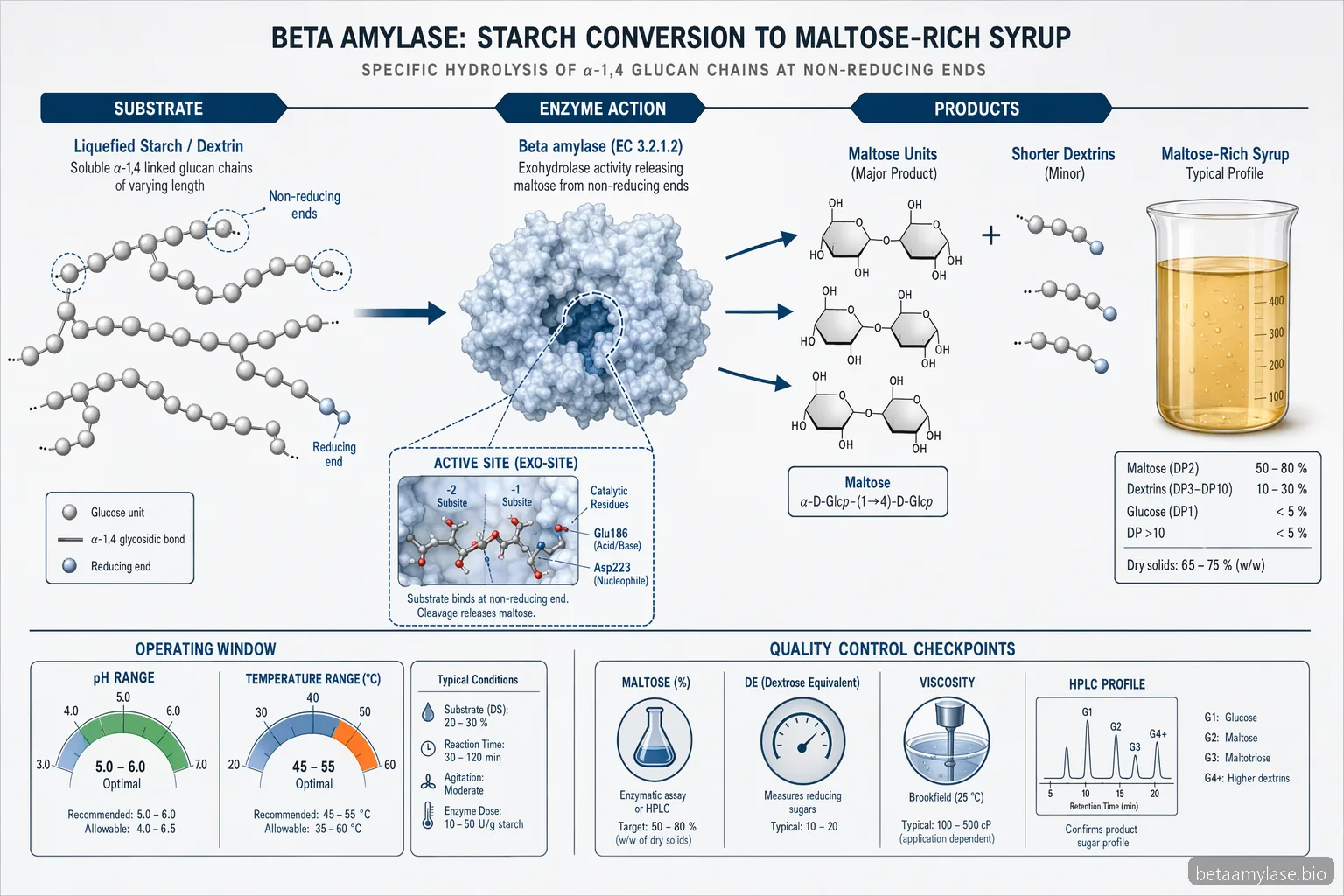
Alpha and Beta Amylase Starch Strategy
Industrial starch conversion often uses both alpha and beta amylase because their roles are complementary. Alpha-amylase rapidly cuts internal alpha-1,4 bonds, reducing viscosity and producing soluble dextrins. Beta amylase then saccharifies those dextrins by releasing maltose from chain ends. In shorthand, alpha beta amylase starch dextrin maltose processing is about managing liquefaction first and maltose formation second. If liquefaction is incomplete, beta amylase access is restricted and the effect of beta amylase on starch may appear weak. If liquefaction is too severe or pH is poorly controlled, fermentability, flavor, color, or syrup specification may drift. Some syrup plants also evaluate pullulanase or other debranching enzymes when higher maltose yield is required, but that decision should be based on cost-in-use and the required sugar spectrum.
Alpha-amylase: viscosity reduction and dextrin formation • Beta amylase: maltose release from dextrin ends • Debranching enzymes: optional for higher maltose targets
Application Fit: Brewing, Malt Extract, and Syrups
For brewing, beta amylase supports fermentable maltose formation and helps tune wort attenuation when used within the mash or adjunct conversion strategy. In malt extract production, it can help produce consistent maltose-rich solids while supporting predictable color, viscosity, and flavor development during concentration. In syrup production, beta amylase is selected when the specification calls for elevated maltose rather than high glucose or broad dextrin content. The chemistry of beta-amylase on starch must be aligned with raw material selection, such as corn, wheat, barley, tapioca, or rice starch, because gelatinization temperature and amylopectin branching differ. Buyers should define target maltose percentage, DE range, viscosity, color, protein carryover, microbial limits, and filtration requirements before requesting samples. Clear application data shortens supplier screening and reduces unsuccessful plant trials.
Brewing: fermentability and maltose control • Malt extract: consistent solids and syrup profile • Syrups: maltose-rich sweetener production • Raw material matters: starch source affects conversion
Pilot Validation and QC Checks
A controlled lab or pilot trial is the most reliable way to measure the effect of beta amylase on starch under your conditions. A useful experiment should compare a no-enzyme control, current enzyme system, and candidate beta amylase at two or three dosage levels. Track pH, temperature, dry solids, viscosity, iodine reaction, maltose by HPLC or equivalent sugar analysis, DE, filtration rate, and final microbial status where relevant. For an effect of beta amylase on starch experiment, sample at multiple time points so the conversion curve is visible, not only the endpoint. Include a thermal inactivation or pH-shift step if the commercial process requires stopping the reaction. Pilot data should be translated into cost-in-use per metric ton of starch, not simply enzyme price per kilogram.
Run controls and multiple dosage points • Measure maltose, DE, viscosity, and filtration • Confirm enzyme inactivation conditions • Calculate cost-in-use at target specification
How to Qualify a Beta Amylase Supplier
For B2B purchasing, request the COA, TDS, and SDS before approving a beta amylase enzyme for plant trials. The TDS should state activity definition, recommended pH and temperature range, dosage guidance, storage conditions, and handling instructions. The COA should identify the lot, declared activity, appearance, and agreed release tests. The SDS should support safe storage, PPE planning, spill response, and worker exposure controls. Supplier qualification should also review batch-to-batch consistency, lead time, packaging size, allergen or raw material declarations where applicable, documentation responsiveness, and technical support for pilot validation. Avoid choosing only on unit price. A product with better stability, stronger conversion at your solids level, or improved filtration can deliver lower cost-in-use even if the purchase price is higher.
Request COA, TDS, and SDS • Confirm lot activity and storage requirements • Evaluate technical support and supply continuity • Compare cost-in-use, not only price per kilogram
Technical Buying Checklist
Buyer Questions
Beta amylase converts accessible alpha-1,4 starch dextrins into maltose by working from non-reducing chain ends. It does not randomly liquefy starch like alpha-amylase and does not bypass alpha-1,6 branch points. In industrial use, its main value is producing a maltose-rich carbohydrate profile after the starch has been gelatinized and liquefied.
Beta amylase is usually added after high-temperature liquefaction, when the starch slurry has been converted into soluble dextrins and cooled to the enzyme's operating range. A common starting point is pH 5.0-5.8 and 50-65°C. The exact addition point should be validated against viscosity, maltose target, process time, and enzyme stability.
In most industrial starch systems, yes. Alpha-amylase reduces viscosity and creates shorter dextrins, while beta amylase converts suitable chain ends into maltose. Using beta amylase alone on ungelatinized or poorly liquefied starch often gives limited conversion. The best balance depends on raw material, dry solids, target sugar profile, and overall cost-in-use.
Compare suppliers by lot activity, TDS process guidance, COA consistency, SDS completeness, sample support, lead time, packaging, and responsiveness during pilot validation. Run side-by-side trials at equal activity units, not only equal weight. The best supplier is the one that reliably meets maltose, DE, viscosity, filtration, and cost-in-use targets at plant scale.
A practical trial should measure pH, temperature, dry solids, viscosity, iodine response, DE, maltose and sugar profile, filtration rate, reaction time, and final product quality. Include controls and multiple dosage levels. If the commercial process includes heating or pH adjustment to stop the reaction, verify that enzyme inactivation works under real process conditions.
Beta-Amylase for Research & Industry
Need Beta-Amylase for your lab or production process?
ISO 9001 certified · Food-grade & research-grade · Ships to 80+ countries
Frequently Asked Questions
What is the main effect of beta amylase on starch?
Beta amylase converts accessible alpha-1,4 starch dextrins into maltose by working from non-reducing chain ends. It does not randomly liquefy starch like alpha-amylase and does not bypass alpha-1,6 branch points. In industrial use, its main value is producing a maltose-rich carbohydrate profile after the starch has been gelatinized and liquefied.
When should beta amylase be added in a starch process?
Beta amylase is usually added after high-temperature liquefaction, when the starch slurry has been converted into soluble dextrins and cooled to the enzyme's operating range. A common starting point is pH 5.0-5.8 and 50-65°C. The exact addition point should be validated against viscosity, maltose target, process time, and enzyme stability.
Do I need alpha amylase as well as beta amylase?
In most industrial starch systems, yes. Alpha-amylase reduces viscosity and creates shorter dextrins, while beta amylase converts suitable chain ends into maltose. Using beta amylase alone on ungelatinized or poorly liquefied starch often gives limited conversion. The best balance depends on raw material, dry solids, target sugar profile, and overall cost-in-use.
How do buyers compare beta amylase suppliers?
Compare suppliers by lot activity, TDS process guidance, COA consistency, SDS completeness, sample support, lead time, packaging, and responsiveness during pilot validation. Run side-by-side trials at equal activity units, not only equal weight. The best supplier is the one that reliably meets maltose, DE, viscosity, filtration, and cost-in-use targets at plant scale.
What should be measured in a beta amylase starch trial?
A practical trial should measure pH, temperature, dry solids, viscosity, iodine response, DE, maltose and sugar profile, filtration rate, reaction time, and final product quality. Include controls and multiple dosage levels. If the commercial process includes heating or pH adjustment to stop the reaction, verify that enzyme inactivation works under real process conditions.
Related: Beta Amylase for Industrial Starch Saccharification
Request beta amylase samples, COA/TDS/SDS, and pilot guidance for your starch conversion process. The application page on industrial starch saccharification lists specs, MOQ, and a free 50 g sample.
Contact Us to Contributehello@mail.betaamylase.bio